

An Interview with the Bouncing Souls' Greg Attonito
Improving communication over time, growing up Italian American, and suffering through press photos.

Hello and welcome to ZERO CRED, the only newsletter about music ever to exist. You can subscribe for free and have it sent to your inbox. Or you can upgrade for just a few bucks a month which greatly helps out and also gets you some benefits.
Today’s post is an interview with Greg Attonito of the Bouncing Souls. Check the interview archive for more chats with people like Everclear’s Art Alexakis, Spiritual Cramp’s Mike Bingham, and more.
The story of the Bouncing Souls is well documented. A group of teenage BMX rats started a punk band right as the 80s were coming to a close and ended up becoming one of the longest-running bands the genre has ever produced, not to mention the pride and joy of their home state of New Jersey. But what’s less talked about is what, practically, it takes to keep a group of friends together for that long.
When I learned that the Souls, one of the most formative bands of my teenage years, were putting out their 13th record, Born to Be, it made me reflect on what an impressive feat it is to stay connected to the same friends since high school. I am lucky enough to have kept a few close friends from that age, but our relationship has changed in the decades since our teenage years. Would we have been able to run a successful operation that travels the world for months at a time and creates new material every few years? Probably not, and that’s what makes the Souls’ endurance a rare and special thing.
There is a wisdom and maturity in the Will Yip-produced Born to Be that probably wouldn’t have been possible in the Souls’ younger days. Themes of perseverance through adversity shine through. There are several references to sunshine and light peeking out from the darkness, even on the album’s cover, which sees a burst of sunlight punching through a dark eclipse. It’s a perspective that frontman Greg Attonito says he owes to moving to idyllic Idaho and driving his son to school through the mountains every morning.
I recently talked to Attonito about the dedication to communication and friendship it takes to hold a group of dudes together for more than three decades, growing up Italian American, and suffering through press photos.
Are you at home right now?
Greg Attonito: I am at home. I live in Idaho now.
You’ve written so many East Coast anthems that put Jersey on the map. Has anyone written the Idaho anthem? Is there a Bouncing Souls of Idaho?
For me, the B-52s song, “Private Idaho,” is sort of the Idaho song for me, even though they’re not from Idaho. It’s not necessarily an Idaho pride song, but I love that one.
They’re stealing Idaho valor then. Have you written any Idaho-based songs?
I’m very inspired by my environment, just as a person having this innate desire to express my perspective of the world. So, Idaho and the environment I live in very much inspires me, maybe not in the same way as that Jersey pride as young guys looking to project our identity into the world in a way that was totally cool, but in a different way. Now, I guess you’d say it’s a little more of a subtle way.
An example is the song on our new record called “The Light.” I was driving my son to school and there’s this cool thing that happens where I live. I live up on a mountain and my son’s school is down in the valley. So we sometimes wake up real early and drive to school. On the mountain, it’s sunny, and then we drive into these heavy fog banks that are sitting down in the valley. It’s pretty dramatic sometimes. It’s daylight, and you drive into a heavy fog, and the sun almost goes away. Then, as you’re driving out of it, that sun filtering through the fog has a really cool impact. And so that waded into that song. “Filtered through this foggy night. We’re all here in the light of our own sunshine.” So, you could say, yes, I was inspired by the environment of Idaho.
But it’s certainly a lot more subtle than saying East Coast, fuck you.
Yeah. Exactly. [Laughs]
I did not realize until we set this interview up that I’ve been saying your name wrong in my head for like 30 years. Attonito. There’s no N after the A.
Yeah, that’s a natural mistake people make. The N is coming later, but our eye sort of sees that N before it’s supposed to come. It happens a lot.
Are you a fellow paisan? Are you Italian?
Yeah, my dad’s Italian. My mom’s German and a little Irish. My grandfather came over on a boat and lived in New York with his eight brothers. He has a pretty classic story.
When you tour Italy, do you feel any connection there?
I do. I remember really connecting to the Italian side of my family. Growing up, my grandfather had a house in Queens and we would go there on Sunday and have dinner for four hours starting at two in the afternoon. I really attached my identity to that side of my family. So I was actually really excited to get to Italy.
I’ll give you a funny story about the first time I went. My name, Attonito, it means “surprise.” It was given to my great-grandfather because this nun found him on the doorstep of an orphanage. They gave him the name, essentially, like, surprise! So we’re staying in Italy, I’m in Milan and we’re beside ourselves. It’s 1996, I made it to Italy. It’s the classic scene where we’re out in the street on a big, long table. We’ve got two bands with Youth Brigade and the Souls and the promoters who are getting dinner for us. I’m sitting next to them and one of them says, “So, Greg, you are Italian, right?” And I said, yeah. He said, “Your name, Attonito, do you know what this means?” I was like, yeah, I think so. And he goes, “It is what you say… deer in the headlights.” And he starts to laugh. I was like, no one ever put it to me that way, but that definitely connects to some aspect of my personality. [Laughs]
I love that. My mom’s side came from Naples and when my family later visited Italy, whenever we mentioned to locals that we were from Naples, they gave us a look like we were hicks. We realized Naples had a bad connotation and we should stop saying it.
Yeah! That’s where my grandfather came from. I don’t how bad it must have been but he just erased that from his history. He wouldn’t even tell anyone. He didn’t teach Italian to my dad and his brothers on purpose because he was probably discriminated against. That’s heartbreaking for me because it would have been great to know the language.
My grandfather was the same way. He was very proud to be an American and from what I understand he did not grow up in good conditions in Italy and he didn’t love talking about it.
Sounds like they’re the same generation, old-school Italians, they keep their mouth shut, they’re not telling you what happened. My grandfather was similar. If the Mafia ever came up, his only comment was, “These are the people who give bad examples to Italian people.” He had a scrap metal business in the city. He must have either had to manage them, or was hassled by them, or there was no avoiding it.
Totally. It’s funny you say that because a lot of non-Italian people in America will glorify how cool the Mafia is from stuff like Sopranos, but when it was brought up in our household it was like a dark cloud came in.
Yeah, it sounds like we’ve got some similarities there.
Something I am coming to terms with as I get older is that men in general, but especially Italian men from the East Coast, are not always raised with good communication skills. But you can’t be a band for as long as the Souls have without having good communication. I’d love to know about the evolution of your communication. You’ve known these guys since you were teenagers. Has the communication among you changed over the years?
Oh, a ton. You hit on a great subject. It’s actually something I might be most proud of, our relationship. It’s the elephant in the room, in a sense. Let’s put it this way: the love that we have for each other is what draws everyone to the Bouncing Souls. There’s something about the Bouncing Souls. We play a show and there’s an energy there. That’s why people keep coming back. We write some pretty good songs, but I think the special event that keeps bringing people back to see us 30 times is the energy of the band.
Somehow, there was a chemistry between us as kids at 16, 17. We felt it amongst ourselves and then when we started playing shows together, we kind of sensed it. But we weren’t great communicators. In that generation, we grew up as kids in the 70s and the 80s. But although the environment wasn’t encouraging us to be emotionally vulnerable, we were able to somehow make it. There were times that were messy, obviously. Somebody would piss somebody off and we would somehow make it through. I think, since we weren’t that good at communicating, we would always joke. We’d joke around in that way of busting each other’s balls. We had this relationship that we could default to, even if something wasn’t going well. We cared about each other and loved each other enough that we didn’t let those tough times destroy everything. Even to this day. Last weekend we played a festival in Montreal. We got in a little thing during soundcheck about a song. I’m not gonna give any details but some person was a little annoyed and then carried it until a little later in the day. But then after the show we all talked about it and then we all worked it out with those tools we have worked at.
Without my wife, I wouldn’t have been able to get better at this. That’s the true test. You can be in a band and live in a van with somebody for 20 hours a day for ten years and it’s still not the same as having an intimate relationship with someone. That’s where you learn what you’re really made of. Thanks to my wife and her patience with me and seeing that even in times when I was not able to express myself clearly and emotionally because of the way I was brought up in my childhood, she was patient enough with me and saw that I was actually really trying. I give her tons of credit for that.
There’s a lot to unlearn.
Exactly. We’re just hardwired as kids, in some good ways and a lot of not good ways, and you’ve got to figure that out. Thanks for bringing that up. I’m so proud of us. There’s a very deep satisfaction that’s bigger than anything else. Bryan [Kienlen, bassist] and I got on the phone and talked about what happened in Montreal and then we checked in with each other and had a good phone chat. We came away very empowered and very conscious of it, patting each other on the back, like, we rule for making it through this day, and this is a big payoff for us.
In therapy they say agreement is not intimacy. Anybody can just agree on things and that feels intimate, but actual intimacy is being able to disagree and have different viewpoints but be able to work through them together with love. You wouldn’t have made it this far as a band unless you had that connective love glue. “Love glue” is a really terrible phrase and I wish I hadn’t used it, sorry.
No, it totally works. I get it. We don’t spend as much time harboring bad feelings, and that takes work. Because those things do come up, but we know each other really well, and we recognize when that’s happening and we listen to each other, and that’s the love.
Born to Be is your thirteenth album. Maybe this is just my own neuroses but I always feel bad interviewing a band that’s been through the press cycle that many times. What’s your least favorite part about releasing an album? I will not be offended if you say doing interviews.
[Interviews] only suck when I’m not really that excited about the record. Then it’s torture. I took a break from podcasts. We didn’t go hard on a lot of publicity for the past one or two releases. So I feel kind of like I’ve gotten a nice, long break. I’m talking about a lot of years, almost from the pandemic. We were doing a lot of Zoom stuff over the pandemic and then I just was like, I’m going cold turkey on Zoom for a couple of years. Justin, our manager, came to me a month or two ago and was like, “You want to go to LA and do some podcasts and some other stuff?” I was like, “Yes! And I can’t believe I’m hearing my voice right now.” I think I’ve had a good break from it and that’s my answer right now. I love the record, so I want to sell it. It’s not my favorite part, but I’m totally excited to get behind it.
Can I make an assumption and you can tell me if I’m wrong on this?
Go for it.
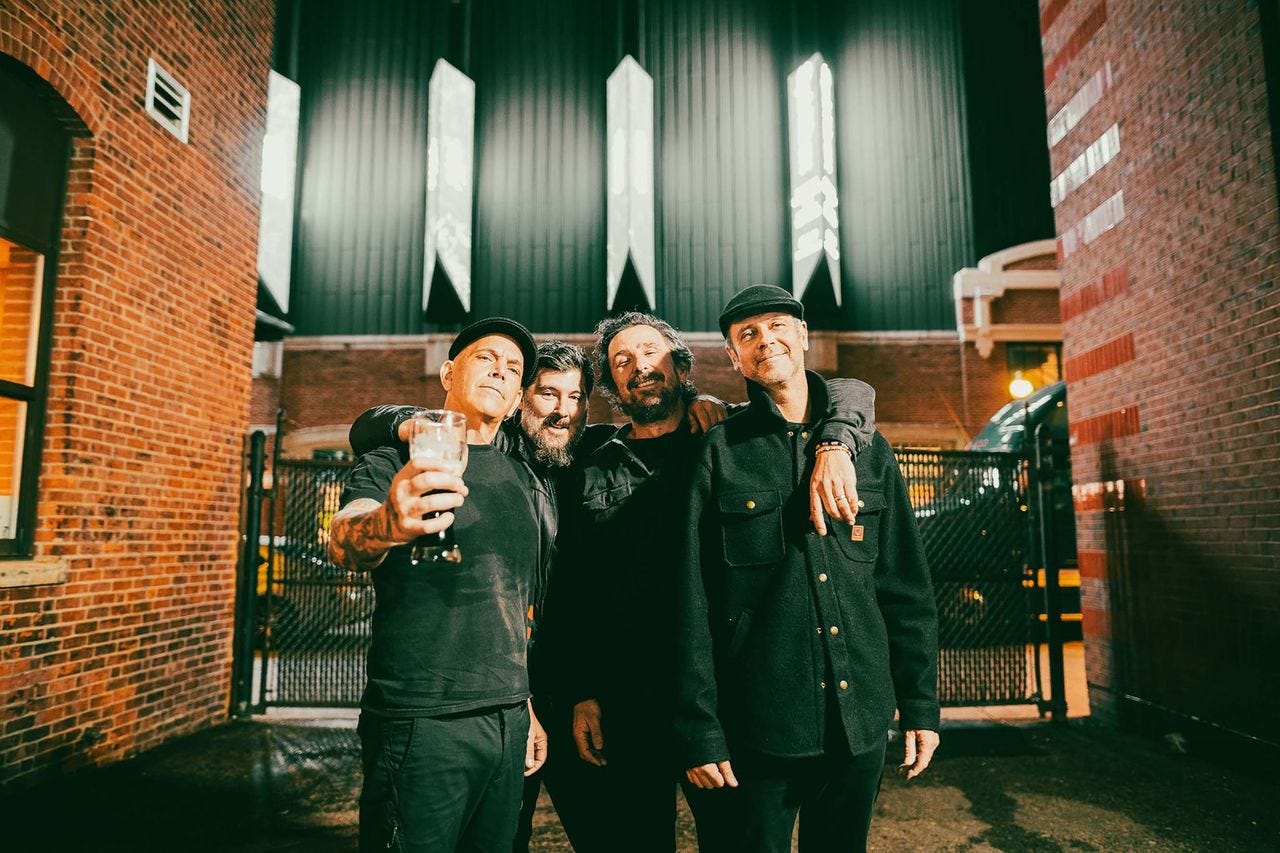
I’ve shot a few press photos for bands, and I can generally tell bands that enjoy doing it from bands that just want to get it over with. Am I right to assume that taking press photos is not your favorite part of the cycle?
Yeah. We grumble through it. When Justin is like, “We need photos, guys,” it’s just a collective groan. It would never happen if not for him saying, “I got this guy who’s coming to the show. Just give him 20 minutes.” And instead of being like, “Thanks, Justin, for helping our band move forward,” we’re all just like, “Ugh, dude, really?” like grumbly old dudes. So yes, you get a magic moment sometimes, but sitting in front of the camera with someone telling you to look natural, it’s like, ah fuck. [Laughs]
I’m always interested when a band puts a photo of themselves on an album cover, because it’s a way of dating you. You guys have done that once, on Hopeless Romantic. I’m wondering how you feel looking back at that album cover. It was a deviation from the artwork you’d done.
This reminds me of a funny story related to that album cover. My son is eight, and he’s been playing drums, and he has a buddy named Dalton who plays guitar and they play together. We were in a record store in Boise and they were looking through the Bouncing Souls section. Dalton picks up Hopeless Romantic. He’s looking at it and he’s like, “Is this picture AI?” I’m like, “Dalton, that photo is so old, so far before AI appeared in the world.” [Laughs]
Speaking of your son and your son’s friends looking at your records, what I find remarkable about watching the Souls over the years is that your fanbase is regenerative. I always expect your crowds to be guys my age who only know the old stuff, but you have so many teenage fans who are always excited about the newest album. I feel like that’s really an anomaly in music. What do you attribute that to?
Over the past 20 or 25 years, we’ve been noticing this more and more, because it becomes this multiple-generation thing once you’ve been a band for 20 years and then you’re moving on to 30 and then you’re pushing 40. I think as every year goes by, it becomes more meaningful. It has more impact and I am more humbled and more grateful. Last year, we saw this new wave of, like, teenagers out in the audience. Anybody younger than 35, you’re like, “Why are you even here? Where’s your dad?” That’s happened to me on tour the last couple of times. I’ve seen some 14, 15-year-old kids come up to me and they’re like, “That show was so cool!” And I’m like, “Is your dad here?” And they’re like, “No, we just like you, man!” But then there is the 20-year-old kid standing next to his dad who’s like, “Yeah, I’ve seen you guys my entire life.” Which is kind of amazing.
I can’t even honestly tell you what it means. It’s so big that the words don’t really cover it. It comes out of the blue for me, because we’re not a hugely famous band. Here’s what I think might be the reason why the 16-year-old kids are out there: Maybe they hear about us somewhere and they’re like, oh, 90s punk. We’re probably in this weird golden oldies world. Maybe their dad or their uncle is into it. And then they go to the show and our energy, in some way, is still more useful than a lot of live music you see out there. There’s an element of us where we’re 50-something-year-old punkers, but when we play that music, the energy is still the same, and that’s why we do it. So I think those 16-year-old kids instantly are like, whoa, this is alive. This is happening. This is not some old band that’s just phoning it in. So that’s my theory on why youthful energy is still there, thank god.
I know you have such a workman-like approach to the Souls, but do you ever think about the band’s legacy at all? Do you care about what happens after you’re gone?
Yeah, Bryan is the one that’s brought that up in conversation. It’s super important to him. It’s important to me too, but Bryan is the one who is like, “Have we accomplished our mission?” And I’m like, yeah, I think we have. We’ve created this real emotional connection with people which helps them transcend their lives. What else can you ask for?
At this point in your career, is there a bucket list item that you haven’t done yet?
Well, I’ve been fortunate enough to also expand out. I do this kids’ music project with my wife called Play Date and I’ve done solo acoustic shows. All those things have helped me satisfy a creative urge. You become a songwriter and a performer and you can’t stop. You see Paul McCartney and he’s putting out a new record. You’re like, “Dude, you don’t have to do that anymore.” But Paul McCartney can’t stop being Paul McCartney, you know? We all can look at him and be like, “You’ve written the most incredible songs, you’ve moved us all multiple times over and over, you don’t have to do this.” But he can’t un-be himself.
When somebody checks off everything, what becomes the motivation then? When you don’t have any finish lines to cross anymore, where does the motivation come from?
It’s about the process, because then you just enjoy the act of sitting down with your guitar. You’re looking out the window and there’s a storm and you want to start singing about it, or whatever drives you in that moment. Paul McCartney, he can’t stop doing that. I can’t stop doing that.
You have this song on the new record, “Asshole Friends,” which is a great title. Something that I always loved about your albums is that you’re not afraid to stick a song or two in there that are a bit sillier than the rest of the material. I always thought having a song about throwing a toilet off a roof was genuinely funny and charming. But I’m wondering if there have ever been ideas that you guys came up with that you cut because you thought they were too stupid or too far out there.
For sure, and some that we wish we had. [Laughs] The song on Comet called “We Love Fun,” that was one that was under debate. It was definitely like, “Man, are we crossing the line here?” Obviously it’s a silly tune but is this totally fucking annoying? Like, we say “put on your party pants.” We were like, “Are we really gonna say ‘party pants’ in this song?” We had that conversation. But finally, we push it through and it gets released. We tried to play it a couple times but decided it didn’t work live. But it landed on a TV show and made us a pile of money. We’ve landed a couple things in TVs and movies, but that one might have done the best.
Isn’t that funny? So many of your early songs were an appreciation for the high school movies you grew up on—Fast Times and all the John Hughes movies. You are a dad now and I’m wondering if you watch any modern teen comedies and if you had any thoughts on them.
I haven’t, but I think the thing about those kinds of movies isn’t necessarily even the movies, but where you are in your life when you see them. Same with music. It’s why the Replacements will always be so special to me. So, Fast Times at Ridgemont High and Breakfast Club, it’s about where my brain was in its evolution at age 15 or 16. My son is going to have those things for himself. We’ve already started showing him some things, not those more teen things, but he’ll watch Ghostbusters and Star Wars.
So I can’t think of any [recent teen movies] I’ve seen, but there are some really cool things people are making now. The world, with all its negativity, is also way more aware and emotionally connected. My son’s elementary school is a completely different environment than what I had. All the kids are supportive and positive and they’re acknowledging issues and looking out for everybody. They’ve really created an environment where the kids are supporting each other. It’s a different universe, in the most awesome way.
This interview has been edited for length and clarity.

MORE INTERVIEWS


FOLLOW ME
Real life: PO Box 11352, Glendale, CA 91226
Great interview! Greg is such a likable person. I remember seeing Bouncing Souls at the Palace in Hollywood where some skinheads were causing trouble, mostly with each other, and Greg stopped the band and said they were going to play Cure songs until the fighting stopped, which they did, and it totally worked.