
An Interview with Author Scott McClanahan
Talking to the author of 'Fights!' about fights!
Hello and welcome to ZERO CRED, the only newsletter ever to exist.
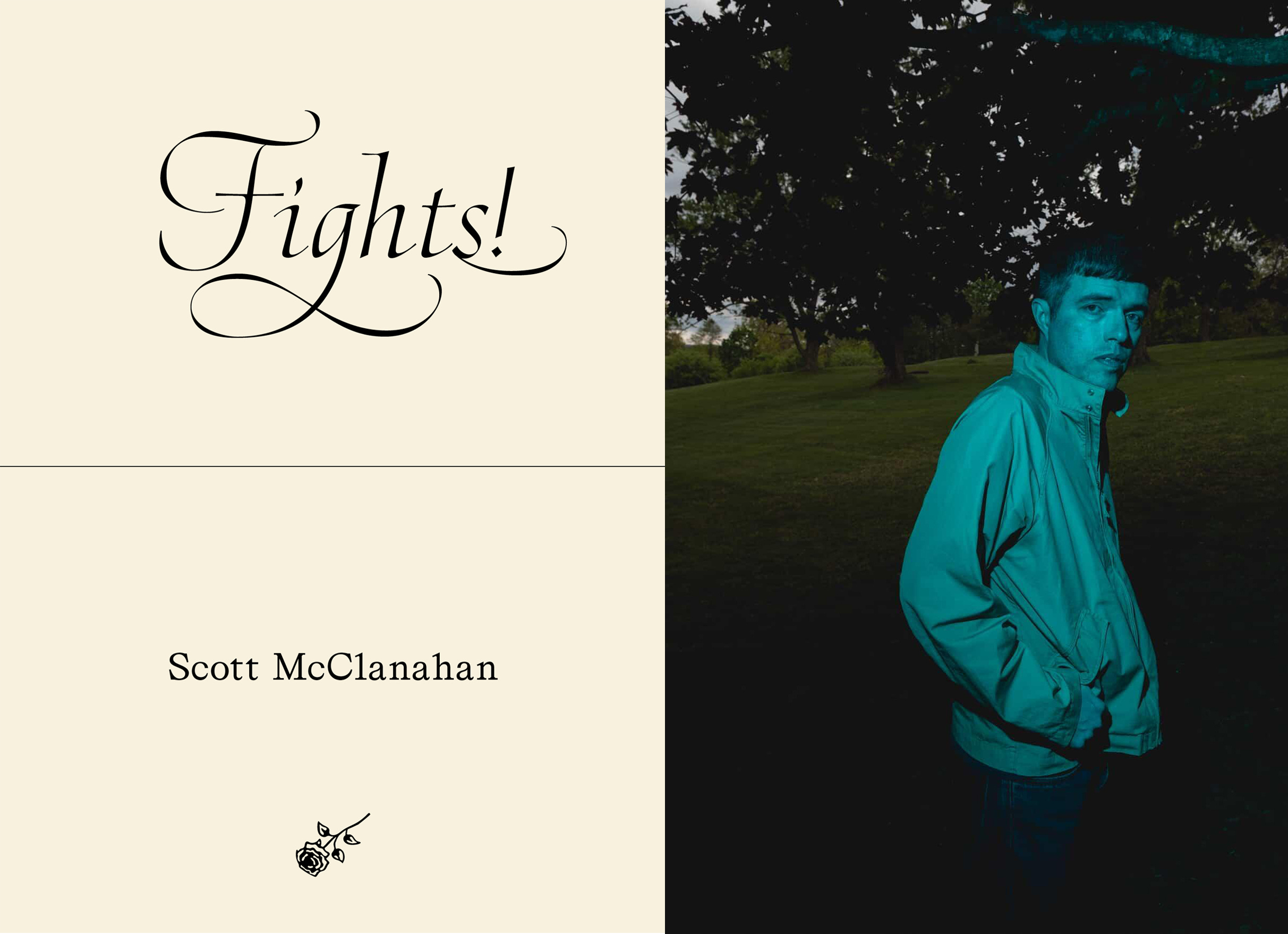
Today’s post is a conversation with Scott McClanahan, author of The Sarah Book, Hill William, and others. Scott has been my favorite living author coming up on a decade now so this was a big honor for me. His new book, Fights!, will be released on July 14 via Chelsea Hodson’s Rose Books, which has also published books by Chris Norris and Geoff Rickly.
There is a second part to this interview coming soon in which Scott and I nerd out about music books. Subscribe and have it sent right to your inbox. Check out more interviews with musicians, authors, and artists in the archive.
Seven years ago I was in a bookstore and saw a copy of a book by an author I’d been hearing about named Scott McClanahan. I opened it and read the first sentence.
“I was the best drunk driver in the world.”
Sold.
I brought it up to the counter and purchased this copy of The Sarah Book. I took it home and read it in one sitting. It was a West Virginia man’s divorce memoir that was both heartbreaking and hilarious. There were moments of sheer male idiocy, like smashing the family computer with a sledge hammer for no real reason, but ultimately the book lands somewhere truly profound. But most of all I loved the writing style. His voice was like the one that runs through my own head, either a dumb guy pretending to be smart or a smart guy pretending to be dumb. It was—and I’m sorry to use a technical literary term—extremely my shit.
Immediately after I finished the last page I drove back to the bookstore and asked what other books they had by Scott McClanahan and bought all those too.
After tearing through Hill William and Crapalachia, I scoured the internet for his books of short stories that were harder to find or out of print. I read those as fast as the post office would deliver them. I guess you could say I was addicted.
So last month when I got a copy of McClanahan’s newest book, Fights!, in the mail, I promised myself I would slow down. I told myself that this would be the only Scott McClanahan book I would get for a while and that I should savor it. A few hours later I was done.
But I learned something interesting while reading Fights! The line about being the best drunk driver in the world that hooked me instantly and started my obsessive reading journey was actually not McClanahan’s line at all. It was something his editor Giancarlo DiTrapano said to him when the two were on their way to visit Breece Pancake’s grave. “I told Gian that was a great line, and I was going to put it in a book one day,” McClanahan writes.
That’s what a great editor can do, inspire moments of genius that others take credit for. Fights! is about fights McClanahan had with DiTrapano, the eccentric founder of indie press Tyrant Books who died in 2021, and also about fights he had with his wife, the writer Juliet Escoria.
Fights! is being released on July 14 via Rose Books. I talked to McClanahan about the state of modern book publishing, writing as a way to sort through grief, and the intimacy of a really intense fight.
I always think about the book-writing process as this language that only you and your editor speak, and then you give it to the world and suddenly it doesn’t belong to you anymore. How do you feel in these last few weeks before everybody else can read the book?
Scott McClanahan: The pretentious answer would be that T.S. Eliot said that a great poem is created by the reader of the poem as well as the writer of the poem. Not that I’ve written a great poem. But I think the real answer would be: It’s awful. It’s truly awful. I think it’s been long enough that I forgot the masochism involved in putting out a book. It’s a balance between those two things in some ways.
Do you like to keep up on what people say about your writing?
I’m not on Twitter or Bluesky or whatever the hell people use. I have a Substack where I read stuff. I like checking Goodreads just because I like to look up other books on it too. Sometimes the nicest things people say to you are… not necessarily insulting, but they’ve got the book as wrong as somebody who absolutely hated the book. There’s a Goodreads review from years ago that I read where somebody just wrote, “Too many characters in this book are giggling.” I was like, “Oh, that’s an excellent fucking note! I have too many giggles!” [Laughs]
But I think I’ve made something that I’m proud of. I was telling Chelsea [Hodson, editor], “I’d face the firing squad with you over this.” That’s a good barometer to have with books, because the firing squad comes for all of us eventually. With a book like this, I think the sustenance that I got from it is in the writing of the thing and in the making of the thing.
I like that you would go to the firing squad for it because I always say that if you write a book and it takes years and then you have to go through several edits and then a copyedit and a legal read and all of these layers, if your book goes through all of those things and at the end you still like it, that’s a good sign.
Yeah, for sure. And what’s nice about the small-press world is you can kind of eliminate a couple of those steps. It’s a weird relationship after the book is done. I kind of forget what’s in the book after it’s complete. Sometimes people will say something to me and I’m like, how in the fuck do you know that? And then I realize: Oh, I published a book and people have read it. People can freely read about these intimate moments.
Fights! is about fights that you had with your editor and fights you had with your wife over a period of time. How did that come about as a concept? Why did you choose to pair those two together?
I thought it was really funny. I thought it would be funny if you had a whole book and each chapter is a different disagreement about something. And also, literary disagreements within the conventions of a novel, for some reason I’m thinking of John Cheever, but simmering resentments that you read in a New Yorker story or something like that, I don’t know if that really exists in life. I don’t know if that’s the type of argument you truly have with your significant other or you truly have with your other significant other, your editor, where you blow up and they’re embarrassing. I kind of think of it as a comic novel, in a way. And also, I love to look back, because if you get a little bit of space or distance between you and the fight, it gets funnier. Think of the worst things that have ever happened to you in your life. You get a little distance and it’s like, oh my God that’s hilarious.
Sure. Tragedy plus time equals comedy, right?
Yeah. So I just thought it would be an interesting narrative conceit, that it would create an energy, and having one right after another would tell a story in the same way of, as an example, Raging Bull. Those fights mean something different each time. So I wanted the fights in the book to have those differences. And also, fights are when I feel most alive sometimes. They haven’t kicked the human being out of you if you’re still fighting.
Fights are quite intimate, aren’t they?
Yeah, for sure. There’s a Tom Waits interview that I love that he did with a Brazilian woman, I think around the time of Bone Machine. She asked him a question, if he’s ever wanted to kill somebody or murder somebody. And he’s like, “I don’t understand people that want to murder a stranger. I’ve wanted to maybe murder people in my family.”
Also, I think they’re healthy. There’s this great text by Machiavelli called Discourses, which is like an analysis of this Roman historian, Livy. Part of the thesis of that book is that disagreements, arguments, fights, so to speak, are good for a society. I think they’re also healthy, especially for an artist. It’s like the famous Orson Welles cuckoo clock speech from The Third Man where he says you look at the Renaissance in Italy and it’s murder, corruption, wars, etc, and they gave us Caravaggio and Michelangelo. Switzerland has had 400 years of democracy and peace and they’ve given us the cuckoo clock.
I think there’s something that is compelling, maybe just on a basic dramatic conflict level. When I was finishing up this book, my wife was like, “Oh it’s another fighting-with-a-woman book.” I had that in the book for a while too, where I had the Gian character saying that, “You’re fighting with women again.” I thought, “Ooh, I can turn it into a trilogy, my fighting-with-women trilogy.” My daughter is now 16 years old, and we hardly ever fight, but it would be funny to have her as the third. Or, I live with my mother-in-law, maybe I can have a third book with her. [Laughs]
I read Fights! the week before I got married, which kind of feels like watching a horror movie right before bed.
Yeah, of course. But I think you also have to be thankful for those moments. I guess that’s what the book is, too. It’s a theme in the book that I don’t even know if I have my head wrapped around totally yet. But I think those are the moments that you’ll recall at the end, the great disagreements. You’re kind of fused as one when you’re inside of a fight with someone. They’re angry and you’re angry and there’s a strange sort of passion that’s part of that. I think that’s what makes relationships, good relationships. You keep fighting and you find different ways to fight. My wife and I, we hardly even fight anymore, which also makes you worry. It’s like, are we still the people we once were? But I think we just know how to fight so much better.
Reading Fights! made me sad for the obvious reasons of grief over a friend, but it also made me sad in grieving for a world that no longer exists. The way you write about book publishing, even just a decade ago, seems so foreign now. A guy saw a clip of you doing a reading on a literary blog and wanted to publish your book. As someone who has been publishing books for a while, can you tell me how you’ve noticed publishing change around you?
Yeah, it’s a 12, 13-year span of time within the book and, shit, even in terms of technology, I lived through 2010 where you put your writing online and you meet all these other freaks and weirdos, who are still my friends. Some of them have become famous. Something happened where it became oppressive. We realized we were living in some sort of techno-feudal society. That freedom, that Steve Jobs bullshit that was spoon-fed to us, like, oh, he’s like Da Vinci. No, no, these motherfuckers were tricking you. They were tricking you the same way that the guy that owned a coal mine in West Virginia in 1920 was fucking tricking you.
In terms of book publishing, I think it’s kind of exciting now, though. Because I think we saw that it was all crumbling. I think that we had a sort of positive attitude about it, that it was crumbling, and now it’s crumbled. With most publishers, I don’t even know if it’s a book thing anymore. It sort of feels like a way for private equity companies or multinational corporations to dump a lot of debt into a particular sphere and then use that for tax write-off purposes or whatever.
Like a Ponzi scheme.
Yeah. But the reason why I say it’s exciting is I think we can return to a place where we can think small. Chelsea’s doing that, where you make your little homemade thing. How do you create value or meaning out of things that are available instantaneously or things that are available basically for free? How do you create value within a particular object? Well, usually, you just make one of them or you make two of them and you make three of them, or you have 500 readers rather than 50,000 readers.
On one level, it’s bleak. I hear awful stories from folks. But on the flip side, it feels like if you ain’t got nothing, you got nothing to lose. So maybe there’s something that’s a little bit more healthy. The dream of 2011 was: I’m going to get a book deal and all you losers can go fuck yourself. And so we stopped believing in one another. We need to believe in one another again. We need more presses to put out one or two books a year. We need more people doing it for just the sheer romanticism of it, because there’s some kind of glory in there.
There is a scene in the book where you talk about choosing to publish a book with Gian instead of a major publisher. Putting yourself in a hypothetical alternate universe, how do you think that would have turned out if you had done The Sarah Book with a major publisher?
To begin with, I don’t even think it was a reality, even circa 2017. There’s no hook with my books. I don’t have that kind of thing that can be advertised or sold. If you look at Publisher’s Weekly now, it’s all, like, social commentary and satire, those particular words are used. In 2018, 2017, it was all mysterious. That was the word on every other novel that you saw sold and advertised. So I don’t even think it was a reality.
Art is like hierarchies. We don’t want to believe that that’s true, but if you get an award or you get a MacArthur, you’re higher up on the totem pole of achievement or whatever. But when it comes down to it, those hierarchies are just crap. It’s just about class, usually, and we’re just reestablishing these class structures of our society within the art world.
So it probably wouldn’t have gone good. I think it would have made me miserable. There was almost a TV show made out of Crapalachia. I was miserable during that. I was thinking like a pirate. I was like, “I’m going to go out there and I’m going to rip some dollars off these kids.” And at that point in time in LA, TV was still TV, and they were giving dumbasses like me money. I told myself, “I’m just going to go into this meeting and I’m going to charm them. I’m going to use that old McClanahan charm on ‘em.” I didn’t realize that that was a trap. They were giving you this money for your time, and your time now belonged to them. So I’ve been close enough to that world, but it probably wouldn’t have worked out too well for me.
I don’t know why, but I have such an aversion to including the names of modern technology in books. I don’t like mentioning apps or Facebook or things like that. I worry that it will date it immediately. I feel like you’ve kept that stuff out as well, but in Fights! you do mention things that happened on Twitter and things like that. How do you feel about making those modern references in your work?
I’ve always fallen on the side that you’re talking about. I don’t want that sort of stuff in my book. I think most of that stuff is kind of false anyway. Is the trending social media topic really something that impacts your life that week? No, it doesn’t. It has no connection to my human heart and what I’m dealing with that week. There’s always those articles, like, Five Great Novels About the Internet. It makes you think, were there newspaper articles like Three Great Novels About the Telegraph?
[Laughs] Yeah, the great American novels about Ma Bell and Con Edison.
Yeah, for sure. But at the same time, that’s also a part of existence. I mean, I wouldn’t be married today without social media, meeting this person at a reading who decided to come because she saw this thing posted online. That’s also a reality. I can remember my friend who met his wife on the internet in like 1997. All of our friend group were like, “What the fuck? She’s coming to see him? He might get murdered or robbed!” And they got married. They had a longer relationship and a longer marriage than all of those friends who were saying he’s going to get murdered. And eventually, four or five years later, they also met their significant others, typically from the internet. Computers are part of my life now, and to pretend that they’re not would maybe be a little bit more false than allowing them to enter into the work.
How do you feel about audiobooks? Have any of your books been made into audiobooks?
Audiobooks, I don’t have any connection to them. I did one for The Sarah Book with this Asheville, North Carolina, company who are my friends called Talking Book, and they do a lot of audiobook-type things. It was torture. Those guys are my friends and are the best and they took great care of me, but my God it was a torturous experience and I didn’t realize how much work goes into that. The reason I did it is there is the Crapalachia audiobook and the voice actor that they got, God bless him, he’s passed away now. I ended up talking shit about this voice actor in some interview, which I shouldn’t have been doing. You can’t do that. Somebody was like, “Oh, that guy died a few years ago.” He was an actor. He’s in the hanging scene in the Coen Brothers’ True Grit. Anyway, he was doing this accent. I don’t even know where this accent came from, but he’s doing like a country-boy accent throughout the whole book. And it was just like, oh my God, this is awful. This is something that I wouldn’t want out there. It’s weird the way people consume books now. My wife listens to audiobooks, and she always tells me I should get into it.
When I was preparing for this interview, I found this post that Gian did on Vice back in 2011, when he was publishing your writing, and I just wanted to read you the quote and see what you thought about it now, 15 years later. He wrote, “This post is destined to be one of those ones that, in years to come, people will go digging through the archive and find this article and be all, ‘Man, this fuck-up knew way ahead of time what the situash was with McClanahan. He’s huge now, and this poor fuck-up died trying to tell us.’”
Gian was a great hypeman. Gian just believed in people. If he loved you, man, he was just going to believe in you until the end, until the wheels came off.
How did it feel to write a book about your editor and then work on it with a different editor?
It’s strange. I almost feel like I’ve done something wrong if I’m being honest about it. I feel uncomfortable. After he died, people did remembrances and they tweeted or they posted, a lot of lovely stuff. I just kind of kept quiet. Then I was like, do people think I’m being disrespectful for being so quiet? But the purpose of the book is I wanted to go find him. I went to Italy a couple of years ago. He was over there in his last few years. Our relationship had changed just because of the distance. I went over there and I was just like, oh shit, he’s not here. He’s dead over here too.
So I needed to find him where I knew he lived and where he lived was in books. Where he lived was in my books. He’s in there. The average reader wouldn’t know, but I have probably 20 to 25 instances that spark a particular memory [of Gian] from just a word that is included in a book.
Do you feel like the book exorcised your grief at all?
The week that Gian died, he was supposed to come stay the night with me. I went into that room where he would have been, in which he’d been in multiple times, in that shitty house that got a fucking bullet through the window, and I just sat there and I wanted to kind of charge that space. I’m not trying to sound all new agey or anything, but I felt like: I’ll be able to find him in here, somehow. If I devote years to this, I’ll be able to find him and he will say thanks to me.
He’s only visited me in dreams twice. The one dream that I included [in the book] after he passed, and then about a year later, I was in Italy for some reason in the dream. I was eating. I was all by myself and I look out of the corner of my eye and Gian is walking down the street and he has a big grin on his face and he’s laughing. I’m like, “Gian! What is going on? You’re supposed to be dead!” And he’s like, “But I’m not dead.” And I was like, “You are going to get us in fucking trouble! You are going to get us cancelled. You can’t do this!” And Gian was just like, “No, it’s fine. It’s all right. They’re gonna love it. They’re gonna love it!” And then the dream ended, and he never again visited me in my sleep.
What do you think he would make of the book if he could read it?
I’ve thought about that numerous times. I think he would do the thing that he did in the book, where he’s like, “This thing sucks, man. You should have edited it a bit more. This is trash. You need to start over again.” And I can hear myself saying, “But Gian, I’ve already published it.” And he would be saying, “It’s alright, we’ll publish a different version. It’ll be Fights Two or whatever.”
But then there’s also the flip side of it where I think he would have loved to be at the center of a narrative, because he loved that. I’m a different personality. I want people to leave me alone. But Gian got energy out of that. He loved people so much that he then pushed that energy back on them in different ways. He was just a very open person. I think he would respect me for trying to come find him, as crazy as that sounds. And maybe I did. Maybe it’s not just in my head.
This interview has been edited for length and clarity.
FOLLOW ME
Real life: PO Box 11352, Glendale, CA 91226
It was really wonderful talking to you Dan.
preordered this morning because of Geoff’s post about wanting to do a book club with it! this is a great read and i’m looking forward to the book even more now :)