

An Interview with Touché Amoré's Nick Steinhardt
Elaborate visual concepts, impressing design nerds, and making art for yourself.
Hello and welcome to ZERO CRED, the only newsletter about music to ever exist. Today’s post is an in-depth chat with a musician and true design wizard.
Subscribe to get interviews like this one, essays, and other dispatches sent directly to your inbox for free. You can also upgrade to a paid subscription for only a few bucks a month which gets you some bonus stuff and greatly helps keeps things running here. Here’s a discount:
Nick Steinhardt is, above all, a problem solver. As a visual designer, he’s the guy who can sort through the hundreds of minute details necessary to bring someone’s artistic vision to life, no matter how elaborate that vision is. Sometimes that means the total creative direction for a Dashboard Confessional album campaign or an animated Katy Perry billboard in Las Vegas, and other times it is the years of dedicated conceptual design work for his own band, Touché Amoré, in which he is also the guitarist.
He’s got a particular gift for imagining and creating impressive physical objects to showcase albums. Lately, his focus has been on making a forthcoming intricate box set commemorating the ten-year anniversary of Touche Amore’s landmark album Stage Four. It’s a four-disc, square vinyl, sonic and visual reimagining of the album.
A few weeks ago, I ran into Nick and his dad at a Stephen Brodsky show and he told me all about this high-concept feat of vinyl engineering. I asked if I could interview him about his impeccable design work and he said c’mon over. So here is a chat we had at his Sunland home recently, with appearances from his dog, Benny.
It was so nice meeting your dad the other night. Do you guys go to shows together often?
Nick Steinhardt: Yeah, my wife’s work schedule makes it tough for her to go out sometimes. She’s a nurse. So he’s kinda my show buddy when she’s not around. There are some artists where I think he might enjoy the show, and if I’m working with the artist, we can go backstage and he gets a little bit of a hang out of it.
Something I love to ask my artist friends is: Are there any moments in your life where your parents have been impressed with what you do? Have you ever seen it set in where they think, “OK, I guess my son did the right thing with his life?”
Yeah, I mean, without sounding a certain way about it, all the time. My mom is a former kindergarten teacher, so I think she’s very much used to that positive reinforcement and the wonder around things. That, combined with the fact that I pursued my artistic passions and made a living out of it, and that I work with some household names that they can rattle off to almost anybody in the world and they know who they are, I think is probably impressive.
Well, you’ve worked with Paul McCartney, who is like the top artist for parents to brag about.
Yes, but even in my twenties, I worked with Britney Spears, Cher, Tom Petty, Eagles, a lot of parent-friendly artists.
What was the first album cover you saw as a kid that you felt drawn to?
A formative music memory was that my dad liked Melissa Etheridge when I was growing up. That was kind of my entry point, that was my first concert. There’s a record—I can’t remember the name of it—but she’s standing facing away from the camera, I believe with a guitar slung around her. It’s a black-and-white photograph, bare back, and she has this kind of M.E. monogram thing that I used to draw. I remember in art class, trying to recreate this black-and-white portrait in charcoal. I haven’t thought about this in so long. You triggered it. [Laughs] But that might be one of the first things I can correlate to what I’m doing now.
What about it?
I don’t know if it was just new to me or that I heard it and I liked it and that was the visual that was associated. I don’t know that I saw that from early days, but definitely in middle school and high school, when I was getting into more alternative music, diving into the iconography around the records and being interested in stylistically whatever was going on. Millencolin was a big band for me. I made a patch of their little bird guy with the X’d out eyes because they didn’t have merch available in the States. But I think after that, probably early high school was when I was really looking at CD booklets and looking at the photos and looking at the layout and the font choices and being like, I want to do this, this is cool.
When you were looking at those first punk and hardcore records, do you remember the first time you had the thought to inquire about who made it?
It was honestly pretty early. I’m thinking back to Millencolin, and realizing it was the guitar player that did all the artwork, and thinking that was cool, and being like, oh, I could do that while I’m in the band. Or any of the illustrators that AFI would have worked with. I remember even some of their t-shirts had a little illustration signature credit. Then you start learning about these bands’ visual universes. And you’re like, are they friends? Did they hire this guy? Did they use this guy for cover art and this other guy for merch? You’re starting to form a scene in your head that you’re not a part of. But I was always looking at the credit.
In ninth or tenth grade, I was really into the band Hopesfall, and I thought their aesthetic was super cool. I remember seeing the credit for Chandler Owen, and he had a URL, so I was checking out his website and his web design. I ended up meeting him at the Troubadour once, as a 15-year-old. I don’t know how many working designers are going to see a band they’re working with and a kid is like, “I like your CD booklet!”
But that was exciting for him, I’m sure, because I think most people take it for granted. Maybe subconsciously they like the way something looks, but they often don’t go below the surface to ask: How did this get made? Who made it?
And it’s funny because it was technically easier then because the way you consumed music, there was a printout that had a typeset line of text with that person’s name on it. Now you need to do a little bit more digging even though ostensibly the information is more widely available because of the internet. It’s weirdly harder to find now. You might be on Spotify, just seeing a thumbnail and there’s no place to look it up.
Now, I’m in a place where people do come and talk to me about the visuals [I’ve made for bands]. So I keep having these full-circle moments of, like, oh, this is the behavior I was exhibiting as a teenager. Other people are still doing that. That’s cool. [Laughs]
Have you paid it forward? Do you have any people who you would consider protégés?
I don’t know about protégés, but I have had a handful of interns over the years, some that have been quite successful. I sort of scouted them out at the art school I went to and brought them into the company I was working at for a summer, and they’ve been quite prolific. But I wouldn’t say I was their mentor.
But I really try to keep an open line for that. If kids at shows or kids on the internet shoot me a message or come say hi and want to talk about this stuff, I’m like, yeah, like, here’s my number, here’s my email, let’s talk. Because I do think that’s how you can foster the future.


I’ve read a couple of interviews where you’ve said you don’t consider yourself an artist because you’re just interpreting somebody else’s work in a design. Do you never make art that’s not project-based?
No. As a kid, I did art class every Saturday and all summer long. But even then, it was a little bit more technical than conceptual. It was never like, these are my thoughts or feelings. It was never like, I need to paint a sun to get this energy out of my soul. I’ve never felt the motivation to need that. I feel like my brain is very practical and pragmatic. I find a lot of inspiration in what somebody else is thinking about or wanting to express. I just don’t have the desire to do it for myself. I don’t know why.
That’s very interesting. Do you have other avenues of expressing yourself?
I mean, in a way, I do feel like I’m expressing myself via expressing somebody else’s vision, to varying degrees. The more meat on the bone there is with an artist’s concept, or how deep their lyrics are, or the more metaphors that it triggers visually, I get way more satisfaction out of that. Even if someone just says, “Nick, can you make me something cool looking?” I’d ask them like 40 questions. I hate making without context. I don’t really know where that comes from other than critique in school where you’d kind of get called out for making an arbitrary decision about a typeface or a color that didn’t have some way of reinforcing it back to the meaning of the project. Even if the assignment was to design a logo for some company, you needed to be able to defend every decision. So I think that just became an ingrained part of my process.
But you never just get hit with a lightning-bolt idea where you say, “Ooh, I’m going to hold onto that for some future project?” It’s always project-first inspiration?
Well, the only personal projects that I’ve done are things I can quickly design and get out into the world, and I don’t have to mull over the decision-making too much. Several years ago I had an idea to make a zine of gas station ice machine typography. I was on tour and seeing this stuff every day—this degraded sign or this machine that looks different or the side of this truck has this really cool hand-lettering in Spanish that says “ice.” That fascinated me, and then my pragmatic brain was like, “Oh, you should make a series of these.” It was called Tour Does Not Equal Tourism. It was a three-pack of zines. The other one was domestic airport carpets—just iPhone photos, face down, of the patterns of all the different carpets of all the airports I’ve gone through. And then the other was buildings that were formerly Taco Bells.
So your creative output is corralling found art.
Kind of, yeah. I don’t know if that’s an easier entry point or that it just makes me smirk. The other major one is my obsession with the 1994 Northridge earthquake. I put out a zine on Jeremy [Bolm]’s label, Secret Voice, that was for the 30th anniversary of the earthquake. I’m from Northridge. I lived through that earthquake. My family had to move out of our house for two years and I feel like, as an adult, I started seeing all this rhetoric and news about, like, “The big one’s coming! We’re overdue!” I lived in kind of a shoddily built apartment in Silver Lake where I was looking around being like, “Oh, this is for sure gonna collapse.” I think, as a coping mechanism, I just started reading more about it. I found a t-shirt that said, “I survived the Northridge earthquake,” and I was like, this is hilarious. I started getting a kick out of it. I’d wear it to the grocery store. Then I just started finding more of them and I started becoming obsessed with how many of these are there out there, how many unique t-shirt designs that are basically like, “I survived the earthquake.”
If I see any at the Rose Bowl or anything, I’ll let you know.
Please do. Now I have a network of people that are at flea markets. But it’s mostly eBay and Depop searches. We sold it for $19.94. It’s 67 pages. I ripped the front page in half, kind of simulating a crack, to make it 67 pages for the Richter scale 6.7. And then we put it out at, I think, 4:03 a.m., which was the time it happened. So yeah, I expressed myself through found art and these one-liner ideas that make me smirk, but then I really lean into it.
How does your approach to design differ in your own band versus when you’re hired by a client to do it?
I would say the process is exactly the same. I think I’m close enough to the music and the aesthetic to where I just instinctually know what choices are right or wrong without having to really ping them off of the client. But I do actually treat Jeremy as the client. I make him presentations about the album’s themes and make sure that they’re all sound and that he likes the aesthetics. Then we go into building it all. I annotate his lyrics, I come up with vast mood boards and reference points for what he’s singing about and how that can manifest visually.
So your presence in the band doesn’t have any impact? You’re not more personally attached to it?
I would say I am more personally attached to a lot of our visual output, for sure. If I’m a part of building the songs and building the record and writing things with several months, if not a year, of lead time on it, that just gives me even more foresight into what it could be, instead of waiting for somebody to call me and be like, “Hey, I need this thing in two weeks,” and then it’s just a scramble.
The Touché stuff and the Deafheaven stuff, I’m so much a part of things early on that it’s very helpful for me, because there’s a longer runway of exploration and I’m very process-driven. One thing ends up being the final, but I might look back on some of that process work and be like, “Ooh, that type choice was interesting,” and maybe that becomes a tour ad or the concept for a merch design.

You make things that are very physically impressive and nontraditional. It’s not just a vinyl color variant. I’m curious, practically, how do you work with printers to pull off a unique vision like that? Like, for example, the Stage Four box set that you’re doing now, that’s very high-concept. How do you translate that to the printer to get it to come out the way you envision it?
At this point, I have a pretty deep network of vendors that I trust who understand the level of detail that I’m after. I’m sort of a conduit. I’m working through a packaging broker or a print rep or something like that. The actual printer, they want to keep you away from the process because they don’t want you to noodle them and be like, “Hm, is that red turning out a little bit too pink on press?” That’s old school. Nobody has money for that anymore.
But the production teams at labels might have a bespoke packaging section of the office or an independent broker that just does this day in and day out. Sometimes they’re sending me samples of things like, “Hey, this is some new stuff we’ve been cooking up.” And sometimes I’m just like, “I have a crazy idea! I’m gonna draw a schematic and call out a bunch of print specifications, let’s get on a call.”
There’s one woman in particular named Diane that I work with a lot. She’s my first call when I have a crazy idea. She’s a vet, just knows her shit and has worked in this industry for decades. She also has this guy that works with her named Randy who—I don’t know if paper engineer is the word—but he can take my drawing and figure out, like, “Oh, we need to have an eighth of an inch of tolerance here for capacity on something.” I’ve sort of prided myself on breaking his brain on a project that I was doing on spec for Senses Fail. It was this multi-sided drawer-box thing that opened from all these different directions. It was quite a feat of engineering, and he was just like, “What the fuck?” But he did it!
Does it always come out the way you imagine?
Oh yeah. Unless the price doesn’t work for the client, I rarely have to compromise. Because—and I’m not touting myself—but generally it’s so cool that it’s worth charging more money for.
Tell me more about the Stage Four box set concept.
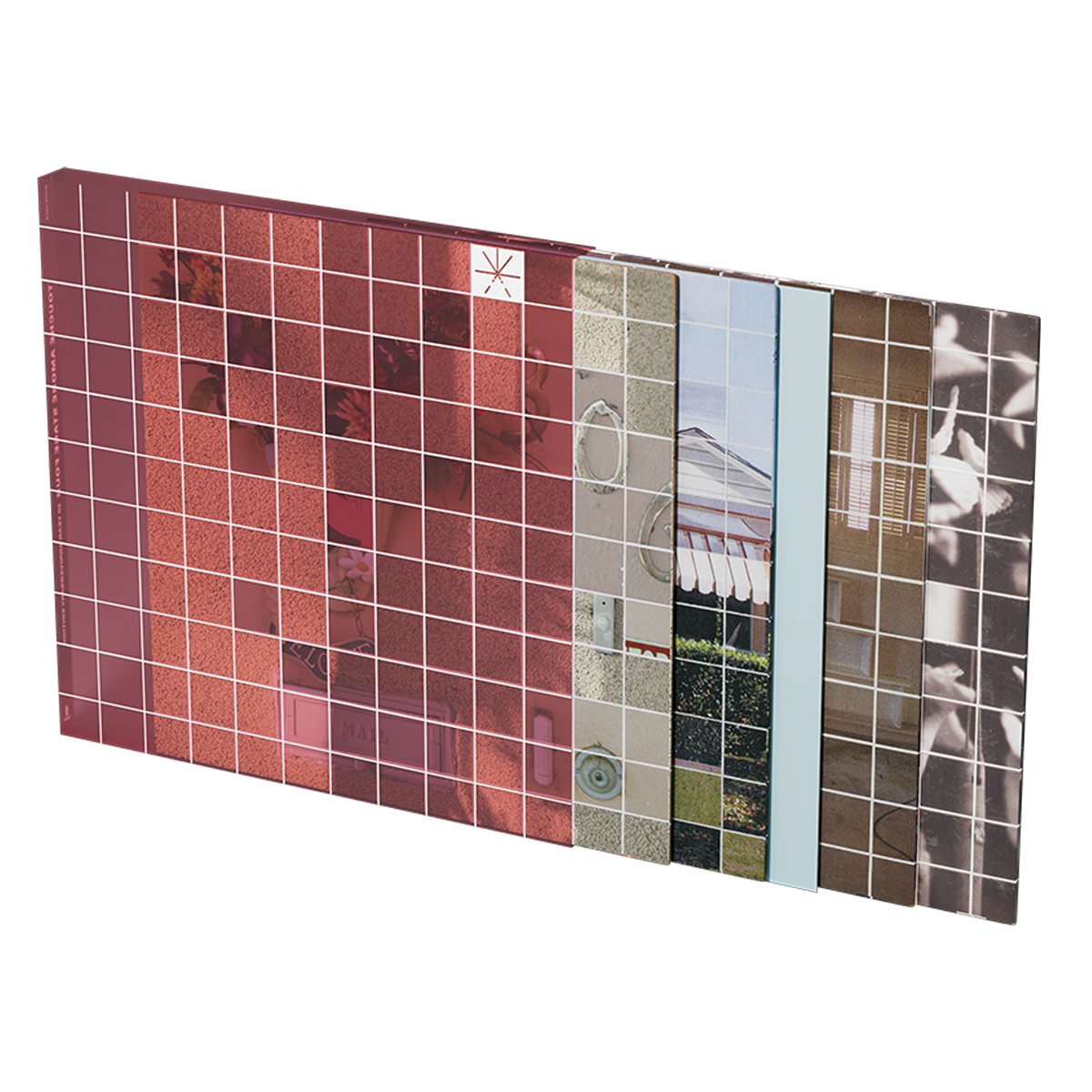
It’s the original record and the full tracklist again as alternate versions. So there’s remixes by Kerry [McCoy] from Deafheaven, Cody [Votolato] from Blood Brothers, Youth Code. And then we reimagined a song and did a stripped down pedal steel acoustic song with this artist named Wisp. There’s a live recording, there’s some pre-production demos that were done across multiple producers and multiple years. Again, my pragmatic brain doubles down on itself and is like: Stage Four, tenth anniversary, the artwork is all squares. I wanted it to be four, ten-inch square discs.
You’re that meme of the lady with the schematics going across her face.
Yeah. Those are my dreams. They haunt me.
I feel like the box set and a lot of the things that you make are so physically impressive as objects, but obviously we live in a world where most people consume stuff on their phones. Do you feel like your stuff gets lost in translation through internet consumption?
Yeah. To put something on pre-order, you have to render three-dimensional images of what you think it’s going to look like. So you’re sort of like, “OK, in this infinite scroll, what’s the first image that people are going to see and does it represent enough that’s enticing about the product or the print specs or the offering to make somebody click and buy it?” There are so many steps between seeing it, clicking it, looking at it, checking out with your cart, etc. So a lot of that goes into consideration—what’s the main image of the carousel? What’s the main image on the product website? You sort of need to have all the contents spilled out to understand how vast the thing is, but then it makes every element so small. Is that grabbing people’s attention? Are they catching the details?
[The box set] is basically a clear, plastic slip case that’s tinted pink and has white ink as text or grid lines on the exterior. There’s four individual sleeves that are collages, front and back. Instead of the center hole being cut out so you can see the label, there’s one tiny little square knocked out of it. The discs are all individual colors, the discs are square, the center label is a floral shape instead of a circle. That was custom. Then, when you take the thing out, the interior of the jacket is printed in a pop of color, so you take it out and you’re like, “Oh, there’s like a little pink square here now,” and then there’s a poster. So there’s so much nuance to explain in a singular image that you kind of just need to be like, is this the sexiest looking one? Okay, let’s just roll with that.
Does it bother you that elements of it will probably get lost in translation online?
No, because I think there’s different levels of appreciation. Maybe some print nerd is going to buy it who doesn’t even give a shit about the record, just to appreciate how detailed the product is. And then there are some that are like, “I just want to hear the Kerry McCoy remix and have that on vinyl.” But I do think there are going to be elements of surprise, at least in the unboxing of it, that are going to make somebody go, “Wait, what?” Because they might not have even understood it from the product mock-up, because it’s so unusual.
There are records that have square discs, but I don’t know how often you’re taking one of those out of a jacket, and it’s rigid, and you’re like, huh? I also don’t know how many people are going to understand that the floral shape on the center label is maybe the first time that’s ever been done. So, I get a kick out of that. My friends, my community of nerds will appreciate that, and that’s what it’s all about. If anybody else does, that’s just a bonus.
One of the things that I love about Touché is that you are in this punk and hardcore scene, but visually, lyrically, I feel like you guys have always been off to the side. Can you tell me the advantages and disadvantages of being a hardcore band that’s sort of its own machine?
Absolutely. Disadvantages are probably that if we were more one-note and that one note happened to be of trend or pop off on a given year, we could have ridden that. But I think, because we sort of exist in these in-betweens, we’ve had a very steady career over the 18 or so years. But it’s been at a very slow incline of success. Year over year, the band is more successful by actual metrics, but if you quantify that over 18 years, it’s quite a slog. I think, yeah, if we were a little bit more obvious, maybe we could have ridden some wave.
But that’s usually short-lived.
It is, but sometimes a wave can lead to getting you on a higher level, permanently. But I do think us existing as our own thing has let us sustain a little bit more. Jeremy will talk about this all the time, but we’re the hardest band on the soft festival, the softest band on the hard festival. We’ll play Brutal Assault Festival in the Czech Republic with death metal bands and we’re the only band with Fenders. Then we’ll play a more indie-leaning festival and be the only band that screams. Both of those things are polarizing in a way that I don’t see gaining a new fan base, necessarily, but the hope is that by being an outlier, somebody’s like, “Whoa, that’s different.”
Years ago, I had Jeremy play my little Rank Your Records game. For obvious reasons, he said that his favorite Touché record was Stage Four. Do you have a favorite album in Touché’s catalog?
It’s really tough. There’s pieces of all of it that I really love. I think Stage Four, on a conceptual level and what we pulled off artistically, is probably the deepest and most meaningful. I love Lament because of how deep we were able to go into building an aesthetic world. I think that was the first time we really did any amount of animation and motion graphics. The deluxe book for that one was really robust and a challenge for me. I basically got to make a bunch of art and then animate it and watch it move and I learned a lot in the process. I just think the art to the video to the merch to the website, everything just looked really proper and cool and interesting to me. We had a lot to play with across a whole cycle.
Do you look at Touché’s catalog, start to finish, and see your own evolution as a designer?
Oh yeah. Lament was literally me looking at our past records and asking, what are the common themes? What are the color palettes that we’ve leaned into? Musically, the record felt like a combination of everything we’ve done but just amped up even higher. So my original mood board and reference points for that record was looking at the color palettes we’ve existed in and juicing them the fuck up. Making them brighter, more in-your-face, more neon, more textural. Just dial it up. And then, conversely, a reaction to that was the following record, Spiral in a Straight Line. In the studio, musically, it felt like we were exploring these in-between sonic palettes. It almost felt like tilting the color wheel into all the colors that we had not used yet. So that was very conscious, saying we’re not going to use reds, we’re not going to use blues. We’re going to go into all these other tangential colors as a way to visually differentiate it because of the sonics. So yeah, it’s all self-referential.
If I knew nothing about Touché Amoré and heard everything you’re saying right now, I’d assume it’d be a very hard band to find an entry point because the storyline is so complex at this point. And yet, I feel like you could just start with Lament if you wanted to and be fine. But if you’re a longtime fan, you’re getting infinitely rewarded with all these things that you’re talking about at a subconscious level.
Yeah, I think there needs to be something for everybody. I think the casual listener can just hop in. But like you’re saying, if you know about it, you might start to notice all the Easter eggs and the hints that have been dropped, even if they’re sort of more of a feeling. It’s very deep because we are so ingrained in it and it is so meaningful. We’re 18 years in and there’s a lot of asking: What haven’t we done? Or should we embrace something that we have done? We’re referencing our own points of reference.
Is it frustrating that most people will never appreciate it at the level you’re talking about?
It is, but there’s a point where I go: That’s for me. That’s where I get my fulfillment, knowing that I expressed a concept to its fullest and knowing that I can explain it to somebody if they asked me about it. But yeah, there’s breadcrumbs and Easter eggs and things all throughout our career.
This interview has been edited for length and clarity.

MORE INTERVIEWS


FOLLOW ME
Real life: PO Box 11352, Glendale, CA 91226
Another band I never got into that I'm checking out now. I like them from what I've heard so far. Thanks!
Square vinyl? WTF?